The Foundations of Zionism
As I write three days after the beginning of the joint Israeli-United
States invasion of Iran, I recall so much just over the past days,
thinking: “Will we never learn from
history?” . Sabri Jiryis is a
scholar, a historian, who cares deeply about truths which oft times are ugly.

Less than two weeks ago I “met” Fida Jiryis, the translator,
and daughter of the author on zoom for the first time. A few minutes later I heard and watched Peter
Beinart interview Sabri Jiryis. He
added greatly to my knowledge. If feels like
a lifetime later. I’m very upset! Now a massive war or ?? is unfolding, after
already genocidal horrific destruction in Gaza, which continues to kill
directly, as well as through starvation and more.
The Foundations of Zionism has helped me learn much
more about (my) history within Judaism; who I am as a Jew. The conclusion of the book was written
proximate to and concluding in 2025.
The core, well over 90% of this book, was written and then published in
1977, 49 years ago.
The books (primarily) traces Zionism from the 1800’s into
the early 1920’s. I was not aware of how
little I knew, until I read this book.
It talks in depth about Theodor Herzl (of course). It discusses how Zionism moved and grew to
the point where he did his work, mostly late in his short life. It also talks of those who opposed him, and
why they opposed him.
I knew a little of how in 1881 the assassination of the Tsar
in Russia brought on massive Anti-Semitism in Russia. Jiryis brought nuance and complexities in
the book, helping me understand things much more deeply. Jews had been significantly middle class
artisans, and industrialization hurt the economic status of many who were not
Jewish. Scapegoating Jews was a good
way out for Russian leadership. Jews
also faced increasing economic hardships, as they didn’t own the new, larger
businesses.
Jews sought both economic and physical safety as they were
pushed into The Pale of Settlement (including parts and all of future countries
such as Ukraine, Poland and Lithuania).
They escaped in large numbers, where they could to the United States, as
well as to Western Europe. Relatively
few went to Palestine because it was complicated to get to, and economically
difficult to survive there.
Zionism was based upon “a Jewish home”, a “safe place” for
Jews to be able to be Jewish, without persecution or death being a major
issue. Palestine (and then Israel) was
supposed to be our (we who are Jewish) historic homeland, regardless of whether
we were/are devoutly religious, or not.
Aaron David Gordon, an immigrant to Palestine from Russia in
1904, was 48, much older than most at the time.
“All our settlements, from their foundations to their
roofs, their vineyards and groves, are founded by the Arabs, who work in
them.” In such a situation, “the country
will not be ours more than it is now, and the people will not be livelier or
less diasporic then they are now, even if we have the title deeds of the land
that our practical Zionists strive for, or the privileges that bring joy to the
hearts of the politicians.” Gordon
stressed that the country would finally “belong to those who suffer for its
sake and work in it more than others”, for “if we do not cultivate the land
with our hands, it will not belong to us in the social or national sense, nor
in the political one.” 190 (p.292)
On page 293, Gordon is further quoted saying:
What have the Arabs created, during their entire time in
the country?... The creation of the Torah, only, gives us an eternal right that
cannot be revoked in the country in which (the Torah) was given, especially
since the people who came after us did not create anything of this
magnificence, indeed, nothing at all.194
The Zionists of the late 1890’s into the 1920’s were a set
of people who often were divided in multiple ways. Some were highly religious, and even amongst
them were those who struggled with it “not being time for the return of Israel”
to those who thought that moving to Palestine was a logical path towards such a
day. Zionists were also: non-religious,
socialist, capitalist, labor union devotees for example and much more
Sabri Jiryis digs deeply into the history of what became
Israel in multiple ways. He is a
scholar, who cares, but doesn’t simply seek simple truths.
The Foundations of Zionism confronts the myth of the
importance of “Ancestral Israel”, as Gordon was quoted speaking of above. Jiryis provides clear data showing how few
Jews emigrated to Palestine out of religious concerns about “ancestral Israel” until
the rise of Hitler in 1933. Oft times
the issues were monetary. Jews came in
and couldn’t make enough money to stay.
Jews who had the money to help their fellow Jews were more interested
(the U. S. a big example) in “being American”, rather than being Jewish.
I knew nothing of the conflicts between Brandeis and
Frankfurter, future and present U.S. Supreme Court Justices and the Chaim Weizmann,
a giant of Israeli history. Weizmann
had a strong tie within Britain related to The Balfour Declaration of 1917, as
well as post-World War I ties to The British leadership under the Mandate.
Much of Zionist beliefs that I grew up with and many fellow
U.S. Jews learned of related to the relative invisibility of the Native
Palestinian/Arab population. Jiryis
effectively shows how there was Palestinian resistance to the evolution of a “Jewish
State” going back to prior to Balfour in 1917.
The resistance was “a problem” and as much as possible it was shoved at
The British leadership. I learned of “Arab
riots”, most notably The Arab Revolt of 1936-1939. Little then – as with now- related to the
non-violent resistance, the attempts at dialogue, and the
racism/nationalism/colonialism that centered upon “othering” those who weren’t
educated and Jewish and from Europe and Russia.
This wonderful book, while not perfect (of course),cl is a
potential source of a lot of learning for a lot of people. It clearly shows how “Labor Zionism” into
the 1920’s and beyond built up the (positive) welfare state as well as the core
systems, such as the banking system, which made a modern state possible. It clearly shows how the Jewish Palestinians
(and later Israelis) profited militarily from the World War I years until 1948
from Britain, primarily.
It exposes an ironic irony that relates to the collaboration
of the Hitler regime with Zionists during a brief “window” starting in 1933,
which helped allow Israel to become a country through multiple positives including
some material advantages, while helping the Nazi leadership both gain monetary
assets to help its economy, as well as “get rid” of German Jews, who were not
allowed to come into the U.S., nor most other “western” countries.
The deep counter-narrative that is clear is how the Native Palestinian
population was ignored, manipulated and in a sense “beaten down” over decades
in so many ways. Palestine had two wealthy
large families. They were played off
against each other by the British. (Clearly,
the British had learned from India, how to divide people by religion and to
seek to be the one who [falsely] “cared” about all – my impression
mainly).
The Zionists were forced to deal with the realities of the
resistance of the native population, as well as the lack of concern of the
British. The native population, not
only were exploited by the wealthy local families, but also by the landowners
who owned the lands that were sold increasingly to Jews. They lived in cities like Beirut, with
another home perhaps for example in Haifa or Jaffa. The native people most commonly lived in
small towns and rural areas and were similar to Black People in the post-Civil
War South, who were stuck financially in servitude to the former plantation
owners.
I’m only briefly touching upon the issues brought up in
depth in the book. I’m giving a second
copy of the book to a Zionist relative, who I think will appreciate much of the
book. He may take offense at the
conclusion of the book which updates things tying together 1947-1948 to 1967 to
1973 (wars) along with Egypt-Suez – 1956 as well as the resistance of the 1980’s,
Oslo, Arafat, and into the PLO and even HAMAS (minimally) and October 7th
until almost two years later, when the writing was finished.
If there is resistance in some, related to the latter
portion (a small part) of the book, I’m fully accepting of it!
Sabri Jiryis spoke meaningfully for me (Beinart interview on
zoom) less than two weeks ago of how he experienced The Naqba at age 10, as his
native village Fassouta (where he lives (again) I think since the mid-1990’s),
remained as a Palestinian Village near the Lebanese border (unlike most, where
the people were forced into exile by the Israeli military). He said that he then began to realize that he
was a second-class citizen in his native country. He said that subsequently as The Arab Jews (also
discussed in the book) were pushed by The Israelis (Jews) to leave their Native
Lands and became second-class (Israeli) citizens, pushing him, and his people,
into being third-class citizens. (Other
Jewish writers have written about their experiences as Arab Jews in Israel.)
Working on racism, as a white man, requires me to be
uncomfortable if I want to really help.
This book may push some to examine (or not) their biases
against The Palestinian People. No one
can/will force the truth upon them. The
denial of many – I hope is starting to be questioned as Jews die from missiles
from Iran.
Our aggression has finally faced resistance beyond October 7th,
that is more than one day’s major attack.
We will “win” (the immediate) war, if it’s even that. I do not welcome the death of anyone in The
Middle East, nor elsewhere. I hope that
those like my relative will hear more and begin at least “the journey” towards
a Just World. In the U.S. the Black and
Brown People respond to my t-shirts – which support Palestinian liberation. It’s the white male Jews – who are triggered
and call me a Nazi, a self-hating Jew, or Anti-Semitic – when my only words to
them are in response to their verbal assault saying: “I’m Jewish” (which makes
me a “traitor” in their minds).
Love is the answer!
Fear – and hatred coming from the fear – may help “win the battle”. It won’t, however, help one relax and feel
peaceful for more than the moment. I
hope that the Iran invasion won’t result in Israel (or The U.S.) starting a nuclear
war, which will likely obliterate all of us.
I have hope, while I also have a lot of deep sadness and anger.
My allies at MECA – The Middle East Children’s Alliance are
wonderful people. One of them said to
me yesterday that we (Palestinians + Jews) are “cousins”. She also told me that we share a history and
present of bad jokes including bad puns.
Fida is a “friend” – someone I care deeply about! It is unlikely, unless I/we win millions in “the
lottery” – with our $6/week Powerball budget – that we will ever meet in
person.
The fear and hatred ends – with meaningful relationships
with the “other” to the point where she/he/they are no longer “the exception” in
our hearts! What I try to do is NOT “heroic”
– at all. The shaming I get isn’t threatening. Those close to the owner of the
Iranian-American bakery and coffee shop that I go to are in danger. My local ally herself– isn’t in “danger” (yet
anyway) but her pain and hurt is far
deeper than mine can ever be. I
try! Thanks!
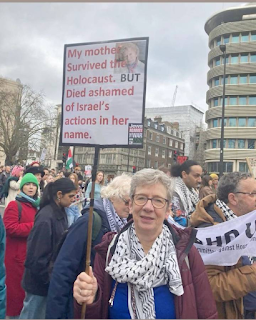
The picture that follows is not from the book but shows the
author and his daughter. Anyone
interested further – see: https://www.georgemarx.org/2023/03/stranger-in-my-own-land-fida-jiryis.html
- which started out as my review of Fida’s INCREDIBLE book and includes a lot
more – including the link to the zoom call of approximately three years ago
where Peter Beinart interviewed her. I
found and friended her on a social media source and now we email each other at
times.



Comments
Post a Comment