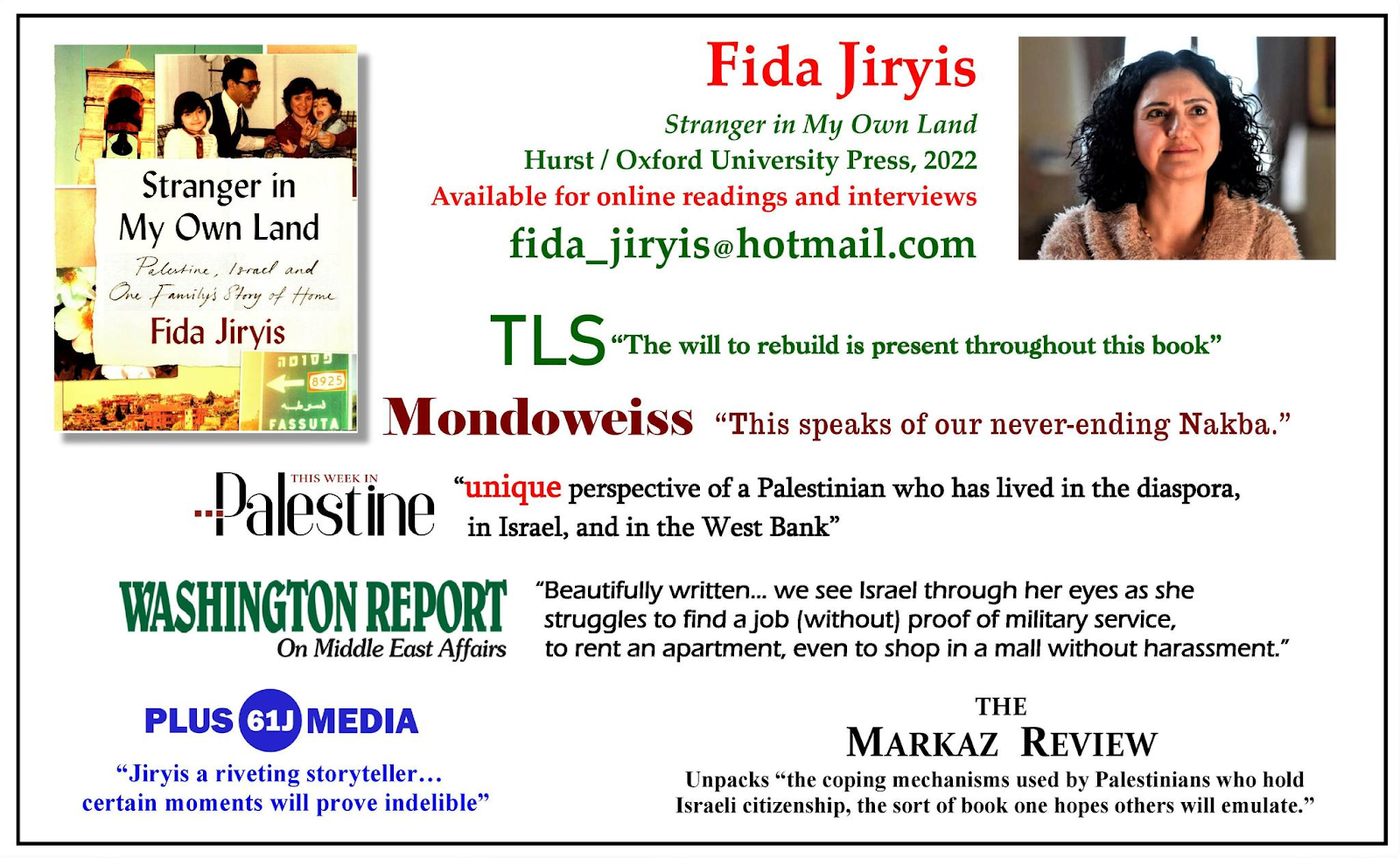
Stranger in My Own Land - Fida Jiryis - READ ME!
Stranger in My Own Land: Palestine,
Israel and One Family’s Story of Home is an incredibly moving,
powerful story that will move all besides die-hard supporters of Israel, who
won’t listen to any message incongruent with their perspective. Fida Jiryis tells her story in a deeply
personal way that brings up nearly all the issues relevant to what has and
continues to go on. She humanizes and
criticizes many, including Arafat, Jewish Israelis, as well as fellow
Palestinians, including herself.
Jiryis has a perfect right to be bitter and
angry. She takes her anger, and uses it
to try to reach us Jewish Americans and many others - who could choose to
listen. She cares about others, both
near and afar. Fida Jiryis is one who
remains an outsider wherever she lives and whatever she does. She is fluent in Hebrew, English and Arabic. She has seen so much! She has learned so much! It goes well beyond “facts” - and does include
a lot that is factual.
What is so difficult for me to acknowledge, is that
for so - so many - her words and she don’t matter! The Palestinian leadership that she seeks,
has largely been obliterated by well over 50 years of murders, assassinations,
imprisonment, exile and much more. She
asserts the obvious, that The Palestinian Authority and Hamas are both corrupt
and ineffective. Her father, a former
Arafat advisor, a lawyer educated at Hebrew University (in Jerusalem), perhaps
is no longer perceived as a threat. He is now 85 years old!
He lost his first wife to a political bombing in
Beirut - which was at a minimum, supported by the Israeli Government. His second wife, a younger sister of his
first wife, and and the author’s second mother - was deeply loved by Fida Jiryis. Her death of a heart attack at 57, while
kidney disease and diabetes ravaged her body, no doubt was really “caused” by
the pressures of living as a Palestinian Israeli citizen in Israel.
When forced to live for several months in Safed in the
mid-1960’s, unable to do his normal work as a lawyer, Sabri Jiryis, Fida’s
father came into a local bookstore, filled with works of noted Zionists:
The titles were by Theodor Herzl, Leon
Pinsker, Moshe Hess, Moshe Lilenblum, Asher Zvi Ginzberg (Ahad Ha’am), Zvi Kalischer,
and Max Nordau. Sabri bought one book,
read it that evening, and came back the next day. The books were small and focused upon the
thought behind the movement. They were
written before the First Zionist Conference in 1897. On the third day, he asked the shopkeeper:
‘Can you sell me everything on this shelf?’
… Sabri bought more than 20 books. (p.110)
1982 - in Lebanon:
It went on for two days. While the Israelis kept guard outside the
(note: refugee) camps, about 350 Palestinians and Lebanese were butchered with
knives or gunned down as they pleaded for their lives and for their loved
ones. (p.218)
The death of Fida’s mother:
No one anticipated the force of the attack
that took place. As the employees were
coming out, a car carrying 550 pounds of dynamite exploded outside, setting the building on fire
and blowing the windows out of nearby apartments.
(p.222) (note: Jirysis’s father survived the attack
while in the same building they both worked at)
My father went to the American University
Hospital, where the ambulances had taken the dead. When he walked into the lobby, he say my
mother, lying on a stretcher.
She had lost her life. (p.223)
Fida Jiryis learned as she moved from Lebanon, to Cyprus,
to her parent’s village in Israel, to Canada, and then to Ramallah, on the West
Bank. She noted:
Yet, the Druze did not gain much from
their allegiance to Israel. The state
did not treat non-Jews with equality, even if they served in its army. The majority of Druze lands were confiscated
for Jewish use, and the state demolished homes in Druze villages where building
permits were denied - just like it did in other Palestinian communities. Their neighborhoods were congested,
underfunded ghettos, like those of Christians and Muslims. (p.298)
Equality? Who
is kidding who?
‘A few Arab boys were working in Atzmon
for a while, but some people were upset and made them leave. And for a few days now they’ve been throwing
stones at our cars as we pass. It’s
really stressful!’
‘Why were they fired?’ I asked.
‘Oh, you know…’ she looked uncomfortable,
waving her hand.
‘Some people just don’t want Arabs working
in the community.’ (p.320)
I guess it’s really tough to be Jewish - in Israel!’
Eva explained. ‘You’ve created a big problem for her.’
‘What?’
‘You were educated abroad, your English is
fluent, you hold a higher position than hers, you make more money than she does,
and she can’t handle it. You’re not the
Arab she’s been told about, the backward, illiterate savage who lives in a tent
and keeps camels. She doesn’t know what
box to put you in.’ (p.348)
Are we talking about apartheid South Africa where we
united to take away “white power”? Is
this Mississippi in the early 1960’s?
No - this is what Palestinians must live with over and over and over and
over again. The Settlers rarely, if
ever, are punished! Palestinians -
nearly always!
His mother fought with the assailants and
the child managed to wriggle free. But,
in the early hours of the morning, a group of Jewish settlers kidnapped,
tortured, and burned alive another boy, Mohammed Abu Khdeir. (p.410)
Chuck Schumer and Joe Biden endorse Israel and condemn
the Palestinians - even more so now, than when these atrocities happened! It has gotten much, worse, the natural
progression - from the past. The
recently elected Israeli Government wasn’t in power yet, when this book was
completed.
The Palestinians didn’t push Anti-Semitism upon us
Jews for many centuries as the Europeans and Russians did! The Palestinians didn’t kill six million of
us - as the Germans, and their collaborators did!
We have been traumatized and need to heal
ourselves! Until we do so, we will
persist in committing Apartheid - my word, not Fida Jiryis’s.
She is remarkably patient - seeking to meet on Zoom
with us Jews, who support her cry for justice!
Watch Peter Beinart of Jewish Currents interviewing
her on February 17, 2023 at:
https://www.youtube.com/watch?v=nxMzA7LjQ8s .
Canadian Book Interview - March, 2023
https://www.youtube.com/watch?v=wwrnBiXu1Lc
https://mediacentral.princeton.edu/media/NESP+Book+Talk+-+Fida+Jiryis/1_w15b2fx9?fbclid=IwAR2ua4kOshkJDovQNKmLm5FAzQ1c-JSd8wg_Iqjg0xtvr6T7hOfb7AY9c40
Interview in Arabic from Palestine
https://www.youtube.com/watch?v=Wqhe4j1J5qA
Maybe then, you’ll make the extra effort to buy this
book. Bookstores won’t carry it - because
they would have to sell it well above “list” for it to be commercially
viable. It is well worth the
effort! I got it one day after ordering
it.
This is an incredible book! The occasional odd typo - can’t detract at
all - from the incredible heart that Fida Jiryis has. Her research for this book is
excellent. Her father and others in her
life are and were real - caring people like her. You won’t be disappointed!
Interview in Arabic from Amman
https://donyayadonya.com/index.php/articles/details/17591?fbclid=IwAR0qChVPJUhh1Mq8qWZbdaVuDMSXhwEIS4ZXzsGobQDgMDXCrZnx1Q9sm-g
A MUCH better review of this wonderful book!
https://www.wrmea.org/middle-east-books-and-more/stranger-in-my-own-land-palestine-israel-and-one-familys-story-of-home.html?fbclid=IwAR3M_MhirMztN1OddhKoRqbNzTkWq2gV7-w5_D5K4Onk0NzkdeW76n8vG-E
1 History, family and person closely intertwined Memoirs of strong Palestinian women The commemoration of 75 years of Nakba is a call not to be forgotten. To continue to empathize with the plight of the people affected by the Nakba and the generations after them. And to continue to resist the injustice that has been done to them. Memoirs are literary sources to capture and share memories. There are numerous memoirs written by Palestinians, eyewitness accounts and experiences of future generations. In this article I zoom in on two examples. First, In Search of Fatima written by Ghada Karmi who personally experienced the Nakba. Second, Stranger in my own Land by Fida Jiryis. She represents the next generation and was born into exile. Both memoirs show the intertwining between historical events, fate of families and individual emotions and experiences. By Marianne Dagevos In Search of Fatima. A Palestinian Story - Ghada Karmi April 1948 "A huge blow shook the house. Something, a bomb, a mortar, a weapons cache exploded with a deafening bang. The little girl felt it inside her head. She put her hands on her ears and automatically lay down with the others on the cold tile floor in their liwan, as she did the last time had become accustomed. They heard shots, immediately followed by bullets whistling past the windows and bouncing off the walls of the empty houses across from them. "Hurry up! Hurry up!" The danger was palpable in the air. The taxi was waiting outside, the doors were open to take them somewhere she didn't want to go. The little girl wanted to stay there, in her house with Rex and Fatima, she wanted to play in the garden, jump over the fence in the garden of the Muscovite house next to them, her friends see again and go back to school that had been closed since Christmas . She wanted to do all those familiar things that were part of her young life. Not this madness. Not this departure away from everything she knew and loved." With this passage begins 'In Search of Fatima. A Palestinian Story' by Ghada Karmi (London, New York: Verso, 2002, translation MD). In April 1948, Ghada was forced to leave her home at the age of 9. She left with her parents, sister and brother, first to Damascus where her maternal grandparents lived, and a few years later to London. Her father had found work there in the Arab section of the BBC and so they became exiles in Europe. Katamon, Jerusalem In this memoir that covers almost sixty years of Ghada Karmi's life, she tells extensively and very personally how her life , the the lives of her relatives and developments in Palestine have passed. In the first part Palestine, covering the period from 1939-1948 at the time of the British Mandate, she describes the Palestinian class society with a majority peasant (fellahien) and a small upper class rural landowners and urban elite. Her father came from a family of landowners in Tulkarem and this allowed him to study and move to the city. The family settled in Katamon (Greek for 'next to the monastery ' in this case the Greek Orthodox monastery Sant Simon), a residential neighborhood in Jerusalem with detached houses where a mixed population of Christian and Muslim Palestinians had settled along with Jewish migrants and other foreign families . Karmi paints a vivid picture of these neighborhoods in Jerusalem, just outside the Old City. They were bustling with life, had their own newspapers, radio stations, literary circles and organizations that dealt with politics, culture , humanitarian work and social encounters. At the same time , Jewish migration increased and these migrants became increasingly militant. The British rulers used a double agenda and played the Arab citizens and the Jewish migrants against each other. Karmi's father gradually lost faith in protecting the British and noticed that they were facilitating the Jewish migrants to take power in Palestine . Meanwhile, Ghada grows up in that beautiful neighborhood, befriends her neighbor girls and builds an intimate bond with the domestic help Fatima who is daily from neighboring village Maliha comes to work for the Karmi family. That Fatima figures in the title of the memoirs. Torn between cultures In the second part, Ghada Karmi herself comes into the picture more emphatically. She describes her childhood in the 50s and 60s in London. The family has found a home in Golders Green, an expansion district in the north where many Jewish families from the European continent have also settled . At school , Ghada tries to appear as English as possible, yet she is treated as the 'dark girl from outside'. Major historical events such as the Suez crisis in 1956 and the June War of 1967 make it painfully clear how wide the gap is between the Arab exiles and the native English. Ghada and her brother and sister feel misunderstood when they express their solidarity with the Arab population and their criticism of Western interference. Their parents go through a completely different processing process, for them Palestine is dead, they want to forget the past and never return to the area that gave them has decreased. Her mother creates an Arab community around her to continue her former life as much as possible and she refuses to speak English for a long time. learn. Her father works for and with the English but keeps private and work strictly separate. His main motivation in exile is that his children receive a good education and learn a useful profession. Within her family , Ghada feels most torn between the two cultures. She loves English culture and feels connected to Arabic. Ultimately, she decides to embrace her Palestinian identity and commit herself to the Palestinian cause. This development is discussed in the third part of the book about the period 1969-1991, the period that coincides with the rise of the PLO. Karmi returns to the Middle East, works as a doctor in Palestinian refugee camps, maintains contacts with the PLO and searches for her former home in Katamon . Looking for the house I also went with my partner in 2022 in Katamon in search of the house of the Karmi family. No address is known, but we did know that after 1948 the house was expanded with an upper floor. Katamon now belongs to West Jerusalem and, with its atmospheric historic houses with large gardens, is one of the most expensive neighborhoods in the city. It is a green, pleasant neighborhood, spacious and quiet and incomparable to the neighborhoods of East Jerusalem. Only Jewish families live there, the Palestinian past and the memories of the former owners are carefully hidden away. Based on a few clues, we wandered the streets until we came face to face with the building with the landing where Ghada had once sat with Fatima during the afternoon rest. To underline the transfer of power, a flag garland was hung over the façade. We did not meet residents, but it moved us that this house still stands as a silent witness of another time. Ghada Karmi has always remained an exile. In England, she is known for her tireless advocacy of justice for the Palestinians and her criticism of the hypocritical and complicit role of the English politics. Unfortunately, her memoirs have never been translated into Dutch and are only available antiquarian, for example from World of Books (www.wob.com). In Search of Fatima is an extremely good example of diaspora literature. Anyone who reads this memoir will get an intimate and penetrating picture of what exile does to human lives. 3 Stranger in my Own Land - Fida Jiryis ' We're leaving.' "Leave?" my grandfather Elias responded. "The Jews are getting closer and closer. We have decided to leave until the weather calms down and we can return," replied his friend, the old shepherd. In two days they were gone. They took everything with them: their clothes, blankets, pots and pans. They even took their chickens with them. Elias' son Sabri knew that because he had gone to see their village. On his father's donkey he had ridden to the Deir, as the village was commonly called. Deir el Qasi was five times the size of Sabri's village of Fassouta and was always very lively. He had often seen the farmers take their harvest from the land to their homes. But as he approached that day, it was quiet. There was no human or animal to be seen. He urged the donkey to walk through the streets and the sound of his hooves reflected off the facades and was interrupted only by the rustling of the wind in the trees. "The whole village, the houses, the gardens and the streets were empty," he says years later. "The wind blew through the houses and cracked the windows. It was the most depressing thing I had ever seen. That image continues to haunt me when I think of the war.' Galilee This excerpt is in the fist-sized memoir Stranger in my Own Land. Palestine, Israel and One's Family's Story of Home (London, Hurst & Company, 2022, translation MD) written by Fida Jiryis. Her grandparents and parents experienced the Nakba in Fassouta, a Christian village in the Galilee, not far from the Lebanese border. As the flow of refugees passes by their homes, the residents of Fassouta do not let themselves be chased away and become residents of the new state. Galilee came under military rule in the 50s and 60s, and Palestinians who resisted Israeli rule faced severe repression. So did the brothers Sabri and Geris Jiryis who founded Al Ard, an organization that stands up for equal rights for the Palestinians. Jiryis poignantly describes how the lives of the brothers and their families are systematically made impossible by house arrest, administrative detention, court cases, searches and retaliation, even decades later. The book also shows how the Palestinian inhabitants of Israel have been systematically deprived of development opportunities since the establishment of the state due to lack of education, lack of job and career opportunities, lack of space and expansion opportunities and constant discrimination and humiliation. For Sabri, who is now married to Hanneh, the situation becomes so dire that the couple has to flee and in 1970 in exile goes into Beirut. A large Palestinian community is active there at that time. A few years later, Fida is born. Her father is director of the Palestinian Research Center and tirelessly writes articles and reports. The young family experienced the beginning of the Lebanese civil war as well as the large-scale invasion of Israel in 1982. In a bomb attack outside the research centre in 1983, Fida's mother was killed. Sabri, Fida and her brother Mousa leave Beirut together with the other Palestinians and the family settles in Cyprus. All this time, contact with the remaining relatives in Fassouta is minimal. Only during the Oslo Accords can some exiles return to their birthplace. Sabri seizes that opportunity, he is still an Israeli citizen, and so the family returns to Galilee after 25 years . The family reunion is considered a miracle and is celebrated in a big way. Father Sabri goes to work for the PLO as an advisor and confidant of Yasser Arafat. Even though the military rule in Galilee has now been lifted, the young Fida has difficulty getting used to the reality of the homeland she had so much about in exile heard. She sees how the Palestinian past is being erased, how the Jewish migrants have taken over the land and power and how segregation between Jews and Palestinians is rampant celebrates. Even with her good university education in ICT and her flawless knowledge of English, she can hardly find a job at a high level and if she is hired is systematically ignored by an Israeli company. A single conversation with Israeli colleagues reveals how ignorant and indifferent they are about the presence of Palestinians in the country. Based on his own observation, Jiryis explains how Israel perpetuates a myth based on ideological benchmarks such as the army, flag, security and the enemy (= the Arab) who poses a threat for that safety. 4 Nowhere at Home Fida and her husband Raji decide to immigrate to Canada in search of more opportunities. They discover that while life in Canada is calmer and freer (no control at malls), as new migrants they are also dangling at the bottom of the labor market, if Production workers have to work long hours for a low salary and can hardly save money for family visits. Their marriage breaks down, Raji returns to Fassouta and Fida settles in Ramallah. She finds out that she is not completely at home anywhere , has to compromise everywhere and has to watch her Palestinian identity under pressure. In this book, on which she has worked for ten years, Jiryis tells the history of the Palestinians, based on research from historical sources , and the story of Palestinian families, based on interviews with her father and uncles and aunts. In addition, Fida reflects on her own life and describes her emotions. On the one hand, the need to belong and show solidarity with her fellow Palestinians, on the other hand, the need for a life of its own with economic independence and room for personal choices. Church of Iqrit During several visits to Galilee we have also visited the remains of destroyed villages, often fenced or hidden under a sponsored forest, an archaeological site or a park with picnic areas. We also visited the descendants of the residents of Iqrit who still hold church services in the church on the hill and have set up camp there. For decades, residents of the Christian villages of Bahram and Iqrit have been waging lawsuits demanding resettlement. This was promised to them by the occupiers in 1948. Until then, they continue to visit the remains of their village. Strong women City-rural, Muslim-Christian, living within Israel or beyond, exile in England or in Lebanon and Cyprus; the differences between the Karmi and Jiryis families are legion. But the daughters, Ghada and Fida, show in their memoirs that they have much in common. First of all, they must deal with the great trauma of loss and humiliation, and then with the ignorance, indifference and denial of Palestinian injustice in the people around them. But both writers are strong women, well-educated and independent, who don't get bogged down in nostalgia and victimhood. They document, analyze and reflect on their lives and on their history and they choose a position of strength. A place to live where human rights are respected must be possible. They will not settle for less. Marianne Dagevos is the initiator of PodiumVoorPalestina.nl, Diasporaliteratuur.nl and VerhalenPost.org. The book ' In Search of Fatima' was accompanied by a podcast that can be found on Spotify: #diasporaliteratuur.
Under The Tree Podcast:
Episode # 77: Stranger in my Own Land with Fida Jiryis
Letters to the Editor: Praise For Fida Jiryis’ Stranger in My Own Land
Palestine in Motion
Fida Jiryis:
A Unique Story of Return
After 22 years in exile in Lebanon and Cyprus, Fida
Jiryis was remarkably allowed to return to historic Palestine.
The Nakba
My father, Sabri Jiryis, was born in 1938 in Fassouta
village in the Galilee, south of the Lebanese border. The Nakba, or Catastrophe, occurred 10 years later, in 1948,
with the founding of the state of Israel on 78 percent of historic Palestine,
the dispossession of around 85 percent of the Arab Palestinian population in
that part of the land, and the ethnic cleansing and destruction of more than
400 Palestinian villages.
Q:Where were the Israeli people before Israel
was created?
In October 1948, Fassouta fell to the invading Israeli army
as it occupied the last part of the western Galilee. The Arab Liberation Army
had collapsed, and people were left to defend themselves or surrender. As
nearby Palestinian villages fell, the Israeli army depopulated many of them,
including Bassa, Kabri, Mansoura, Tarbeekha, Iqrit, and Biram.
Fassouta, by a stroke of fate, was one of the villages that
remained. Dayr al-Qasi and Suhmata, two villages lying next to it, were
completely depopulated. Some of Suhmata's people stayed and became internally
displaced persons, but the remainder, with the people of Dayr El-Qasi, made
their way north into Lebanon. As a child, my father was startled by a large
group of refugees at his grandfather's house; the old man had taken pity on
them and brought them to Fassouta to give them food for the journey.
Q:How many Palestinian villages have been
destroyed since 1948?

I saw the Nakba with my own eyes. Dozens of men, women
and children, uprooted from their homes, swept in fear and terror into the
unknown. A few weeks later, I ventured into Dayr El-Qasi. The village, with its
houses, gardens and paths, was completely empty, the wind blowing through it
and grass growing everywhere ... A lone chicken scampered about. I've never
seen anything more depressing. The image continues to haunt me, when I think of
the war.- Sabri Jiryis on the events of 1948
My father did well in primary school in the village and his
father sent him to the Terra Sancta boarding school in Nazareth for high
school. Few children could continue their education in this way; the village
was remote and poor, but my grandfather, Elias, was a shepherd and owned a
large number of livestock. He grazed them and traded with the shepherds of the
nearby villages and was shocked by his friends' displacement. Times were
uncertain; three attempts were made by the Israeli army to evict Fassouta's
residents in the following months, but each time, the soldiers stopped short
and left under orders from their commanders. The refugee crisis was at its peak
in the region, and Israel was under international pressure.

One day, coming home on the bus from Nazareth, my father saw
several bulldozers working at the site of Suhmata, tearing down its houses and
lifting the stones away. The man sitting in front of him said: "They're
taking the stones to use to pave the road."
These events, together with the harsh military rule Israel
imposed on all Palestinians in Israel from 1948 until 1966, shaped his
consciousness of a horrendous injustice. He went on to study law at the Hebrew
University in Jerusalem, and, in 1959, while still a student, he cofounded
"Al-Ard" (The Land), a Palestinian national resistance movement, with
Mansour Kardosh, Saleh Baransi and Habib Qahwaji. The movement's name signified
the Palestinians' attachment to their land and their right to their country. Al-Ard
published a newspaper and urged the Arabs in Israel to organise and handle
their own affairs. It aimed to find a just solution to the Palestine problem
and called for the return of the refugees and the establishment of a
Palestinian state alongside the Jewish state, in accordance with the 1947 UN
Partition Plan for Palestine. The movement's leaders were open in their desire
to cooperate with Jewish progressive and democratic groups.
Q:What is the UN Partition Plan?
Al-Ard was targeted by the Israeli authorities and described
as a danger to Israel's security; they refused to give it a licence to publish
a newspaper, harassed its members, and prohibited them from registering it as a
company and a printing press. The members printed their newspaper under a
different name each time to be able to circulate it. They also managed to reach
out to the UN Secretary General with a 17-page memorandum exposing the plight
of Palestinians under Israeli rule. At this, the Israeli government outlawed
the movement altogether. When Al-Ard tried to register as a political party
list in the 1965 Knesset (Israeli parliament) elections, it was forbidden, a
decision that was upheld by the Supreme Court. The state dissolved the
movement, classifying it as an "illegal" organisation, and expelled
its founders to separate, remote towns with no Arab populations until the
Israeli elections ended.

Ahmad al-Haaj comes from a long line of Palestinian
peasants, forced from their homes by Zionist militias in 1948.
In 1966, my father wrote The Arabs in Israel,
one of the first books about the Palestinians who remained inside Israel after
the Nakba. From a legal perspective, he revealed, in detail, the harsh fate
that befell these Palestinians under Israeli military rule. The book became a
landmark document about the Palestinians in Israel, with its thorough treatment
of their systematic oppression by the state. Their land was confiscated; their
villages were razed to the ground; they were denied freedom of movement,
employment and expression; they were treated as suspects and harshly subdued if
they engaged in any activity to resist or demand their rights. All of this was
clothed in "laws" passed by the new state to give its actions a legal
pretense, while, in fact, they contravened all human rights. Israel had erected
itself on the remains of another people; nothing could be legal when built on
such an atrocity.

At the same time, my father met my mother, Hanneh, at his
friend's wedding in Fassouta. A few months later, his marriage proposal met
initial rejection from her family, who were worried about his political
activities. Hanneh had been orphaned at an early age when a stray bullet, fired
in celebration, killed her father at his cousin's wedding. Her mother had
struggled to raise her six children; Hanneh was bright at school and her
maternal uncle took her with him to Nazareth, where he worked as a teacher, and
enrolled her in school there. She went on to study economics at the Hebrew
University in Jerusalem and was also politically aware; when my father
proposed, she countered her family's objections and insisted on accepting him.
In 1968, they were married and moved into a small apartment in Haifa.
Q:What kind of citizenships do Palestinians
have?
But the harassment my father faced was constant. My mother,
a new bride, was "running after him between police stations and
prisons", my grandmother later reminisced. Escalating pressure against him
and repeated periods of detention and house arrest came to a head when his
brother, Jiryis Jiryis, was involved in an arms-smuggling attempt from Lebanon
to the West Bank in February 1970. The attempt failed and Jiryis was shot in
the leg as he escaped across the hills into Lebanon. A few months later, my
parents also left and joined him.
Beirut
In Beirut, my father joined Fatah (the Palestinian political
faction) and worked at the Institute of Palestine Studies, then as director of
the Palestine Research Center of the Palestine Liberation Organization (PLO),
and Yasser Arafat's adviser on Israeli affairs. My mother worked alongside him
in the Center as a writer and researcher of economic affairs. I was born in
1973, and my brother, Mousa, in 1977. My mother was devoted to us, doting on us
incessantly with deep love and caring for our every need; perhaps, sadly, she
had a premonition of what was to come.

In 1981, after her father's death in Rome, Samaa Abu Sharar
began a long journey from anger to reconciliation.
We lived in Corniche al-Mazraa in west Beirut. My mother was
very lively and sociable and our apartment frequently filled up with guests.
She also imparted a deep sense of our extended family to us, always telling us
about "teta" (our grandmother) and our uncles, and sitting by me to
help me compose letters in my childlike script to them. The letters and
photographs were delivered by a kind priest from Fassouta who traveled back and
forth to Lebanon and had immunity due to his religious status. There was no
telephone communication between Lebanon and Israel; this was my parents' only
connection to their families, together with verbal news that the priest would
relay to each anxious party about the other. As an adult, I came to realise
what my mother must have felt, cut off from her family for such a long time.
She wanted her children to know their roots.

My childhood memories were happy until the early 1980s, when
I began to be conscious of the effects of the ongoing Lebanese civil war on our life. We had constant
electricity and water outages; we missed school; the letters and homework had
to be done by candlelight; my parents were stressed and we often had to leave
our home to find shelter in safer neighbourhoods with friends.
Q:Where do the Palestinian refugees live?
In June 1982, Israel invaded Lebanon and, in September, its
allies carried out the Sabra and Shatila massacres in the Palestinian refugee
camps. In the ensuing months, the world went insane. I have a flashback to my
mother holding me and Mousa by a hand and running with us down a street as
shelling raged overhead. We were frightened and found ourselves frequently
dragged down to the underground basement of our building, which served as a
shelter for dozens of families. But she could not protect us forever.
A few months later, in February 1983, she was killed in a
bomb attack on the PLO Research Center, which took the lives of eight of the
Center's employees, two guards and many passersby, and injured hundreds. My
mother was 37; her friend, Sabah Kurdieh, was 28 and left behind three sons.
Her other friend, Suad Hayek, a Palestinian from Nazareth who lived in our
building, lost both legs in the explosion, screaming pitifully in the midst of
the scene. I still wonder at the survivors' ability to stay sane.
A funeral was held for my mother in Beirut, another in
Fassouta. I was 10 years old; my brother was six. Her loss had a lasting,
profound impact on our lives; until today, my heart breaks the most for
children who have lost their mothers in wars.

Cyprus
Devastated and traumatised, we moved to Cyprus, one of the
few countries that opened its doors to Palestinians at the time. The PLO
Research Center was reopened in Nicosia on a smaller scale, as were several
Palestinian publications.
My father married my mother's younger sister, Najwa, who
became a kind stepmother to us. We lived in Cyprus until my early twenties,
with no possibility of returning to our country. Yet Palestine was always in
our home; my brother and I grew up with an acute awareness of our identity. I
went to demonstrations organised by Palestinians and Cypriots, protesting
Israel's repeated wars on the Palestinians. I wore the checkered
"keffiyeh" - the black and white scarf of Palestine, attended
performances given by visiting Palestinian artists, listened to our music, drew
our flag on my school books, and, in ninth grade, I proudly wore a traditional
Palestinian dress to a multicultural event at my school in Nicosia.

At home, my brother and I were raised on our culture, food
and language. My father insisted on Arabic lessons for us. Many of our
relatives in the Galilee came to visit. And all the while, a picture was strong
in our mind of us belonging elsewhere, of our life abroad being temporary until
we could go home. Yet our return was never possible.
Until the Oslo Accords were signed on September 13, 1993.
The Oslo Accords
I was 20 years old and a student of computer science at
Lancaster University in England. Back home in Cyprus for a visit, I found
myself sitting with my family, watching the accords signing ceremony in shock.
The historic handshake between Yasser Arafat and Yitzhak Rabin was seen to be
the start of a new era of peace and reconciliation. My family, like many
others, was overjoyed, thinking that this was it: peace would prevail and we
would go home!
Q:Why did the Oslo accords fail?
In November 1994, a year after the Accords were signed, and
in a turn of events we had never imagined, my father boarded a plane and went
home, after 24 years of exile. Two weeks later, we joined him for our first
Christmas in the Galilee.
The Galilee
Our homecoming was painful, bittersweet, and overwhelming.
My father was welcomed into Fassouta with a "sahjeh", a Palestinian
folk dance, and spent three days receiving an unending tide of visitors from
the village and outside it. When we arrived, we were welcomed with tears and
intense emotions; our return had been nothing short of a miracle, yet our
mother was missing. She had left 25 years prior and had never returned.
Q:Who are the Palestinian Bedouins?
Walking around the village, I felt I was retracing her
footsteps. Here was the home where she had lived, here was the same, wooden
cupboard in which she had hung her clothes. That was her family, the people she
had grown up with. I found her letters to my grandmother, in which she proudly
wrote about us and our excellent grades at school and urged her to obtain a
passport so that they could arrange to meet in Cyprus. It had then been 13
years since their separation. "I fear I may never see you again," my
mother had written.

I resolved to return as soon as I could, to be in the same
place she had been. In any event, the PLO was moving all its institutions, and,
in June 1995, we made our final return from Cyprus to Fassouta. Ours was a
tiny, special case. Although the accords allowed the return of about 4,000 PLO
personnel to the Palestinian territory in the West Bank and Gaza, only a very
small number of exiled Palestinians were allowed back into their towns or
villages inside Israel. The maximum is estimated at less than 10, a number so
small that I do not know anyone who returned like we did.
But, for me, the return couldn't have been more bizarre.
Born and raised Palestinian, carrying the baggage of my parents' exile, the
horrors of the war on Lebanon, and my mother's loss, I became, overnight, an
Israeli citizen, one of 1.7 million Palestinians living inside Israel, trying
to live in the very society that had inflicted all this upon me.
Q:What is the difference between the terms
‘Palestinian in Israel’ and ‘Israeli Arab’?
As the dust settled on my initial homecoming euphoria, I
fell into a long struggle and turmoil, a social schizophrenia such as I had
never experienced. My integration into my own, "Arab Israeli" culture
was also fraught with difficulty. I could not find anyone who could understand
and relate to me; people my age had grown up in this reality and knew nothing
else. It took me many years to form the true picture of our plight.
Hatim Kanaaneh was the only Palestinian physician in his
ancestral home village of Arrabeh in the Galilee.
Today, 70 years after the establishment of Israel,
we are citizens of this state, but our citizenship is far from equal. We can
vote; we have access to education, employment, healthcare and social benefits;
we are free from Israeli occupation, military checkpoints, army incursions and
Jewish settler violence endured by our brethren in the West Bank and Gaza. Yet,
underneath this facade is a complex system of discrimination in every aspect of
our lives. In Israel, Palestinians are viewed and treated as an inferior,
unwanted segment; their rights are abused; the number of racist policies and
laws against them continues to rise. They can work, but are largely in
lower-paying jobs than Israeli Jews. They are not welcome in Jewish
neighbourhoods and are forbidden from living or working in many Jewish communities.
Q:How are Palestinians in Israel treated?
They cannot get the same kind of loans for education and
housing. Legally, they may still be subject to random administrative detention
that can drag on for years without trial. And, perhaps most tellingly, Israelis
and Palestinians live segregated lives, with interaction between them at a bare
minimum.The Palestinians' frustration has an added layer, that of Israel's
violence and aggression against their brethren in the West Bank, Gaza, and
neighbouring countries. This, together with the challenges of daily life in the
state, has, through the decades, caused Palestinian citizens to erupt in
clashes with the Israeli establishment, making it even clearer that the country
is far from being an equal home for all its citizens. Things have not changed
much since my father wrote his disturbing book 50 years ago.
Q:What is the separation wall and how long is
it? How high is it?
I felt all this in interactions with Israeli Jews in the
workplace, on the streets, in malls, and in government offices. In the eight
years that I lived in Fassouta and worked in nearby Israeli technology
companies, I do not recall ever being happy or feeling free. Israel has a
pervasive, heavy feeling of oppression and racism for its Arab population; we
are the enemy, a "fifth column," a "demographic threat" to
the "purity of the Jewish state".
I could not cope with these racist notions, nor with daily
life in the country. In 2001, I spent some months in Scotland finishing my MBA,
then I returned to Israel, worked for one more year, and, in 2003, I left it
all and emigrated to Canada.
Diaspora
Once again, I was far from my homeland, though this time by
choice.
I settled in Kitchener, Ontario, but it took me little time
to realise that I would not be at peace in Canada; I carried my home inside my
heart. I battled internally with my unhappiness in both places, until, in 2009,
six years after moving, I was on a visit back home and finally chose what
seemed to be a saner option: to relocate to Ramallah in the West Bank. I had
friends there and I had felt relieved and happy during my visits; the city had
a semblance of Palestine and Palestinian sovereignty, and, along with hundreds
of other Palestinians with Israeli citizenship who moved there, I felt that I
could be in my homeland, but far enough from the oppression of life in Israel.
Q:How many Palestinians are in the diaspora

Quickly, I realised that life in the West Bank is a side of
the same coin: that of Israeli aggression and control over Palestinian lives.
Here was a much starker reality, one that few Palestinians in Israel really
knew: the separation barrier, severe restrictions on people's movement,
checkpoints between all Palestinian towns, Israeli army and Jewish settler
violence, Israeli theft of Palestinian resources such as land and water, forced
displacement of Palestinians from their homes, and an endless cycle of violence,
arrests, and the incarceration of large numbers of the population.

Raed al-Sakakini and Ayda Addas made a painstaking decision:
leave Lebanon in search of safety for their children.
The Oslo process has, 20 years later, resulted in
Palestinians living in Bantustan-like arrangements on their land, shredded by
illegal Israeli settlements and more than half a million Jewish settlers and
making the realisation of a viable Palestinian state impossible. Our economy is
severely curtailed by movement and trade restrictions; we survive mostly on
donor funding from Arab and western countries.
Q:Why doesn't the Palestinian Authority
nullify the Oslo peace accords?
Today, I feel as most other Palestinians do: cornered by
Israel at every turn. My experience of living in both the Galilee and in
Ramallah has given me the larger picture, a bleak one of racism and violence,
with little hope of living at peace anywhere in our homeland. My mother's loss,
my family's suffering and my constant moving and insecurity are a direct result
of Israel's establishment and the dismal reality of life for Palestinians
within it.

Comments
Post a Comment